*Richard Attenborrough*1982*188m*English*Ben Kingsley*
Attenborough's achievement should not be belittled. Not only the life and personality of an extraordinary individual but half a century of history has been reduced to a crowded canvas of three hours. That this should have been done not by a compatriot but an Englishman perhaps underlies Gandhi's universality and timelessness. I must have seen this film perhaps four or five times, but the present viewing was one of my major cinematic experiences, perhaps because the subject matter has come to mean more to me now. I have heard it said that the historical dramas of Shakespeare ( with all inaccuracies and biases ) came to be the history of England more than the real history. Ironically, an Englishman has captured the essence of the freedom struggle and it's central inspirational figure. It is a more than adequate portrayal and has made this period come vividly alive in my mind. I think it needs to be said that the nationality and passport of the film maker should not be allowed to cloud one's evaluation.
The period from 1850 in India produced a series of moral and intellectual titans, who were clearly able to grasp the oppressive and humiliating nature of the British occupation of India. Even among this constellation of luminaries, Gandhi is a phenomenon extraordinary, who appears almost as though by predestination to open new pathways in human history. What is the essence of the power of love he wields on the common people, or the moral strength which ties up the colonial masters into knots of perplexity and consternation? As he says in the film, " We, not they, are in control." The initiative, if not superior brute force, was with the freedom fighters. They had the upper hand, because justice lay on their side. It is a classic battle of right versus might, of moral spine arrayed against the baton and bayonet.
Shortly before this film, Attenborrough gave a brilliant portrayal as an actor in his role as General Outram, in Ray's Chess Players. He has a truly admirable grasp of the Indo-British inequation and a panoramic view of the history of the period. The Jallianwala Massacre, in it's incredible ferocity, is portrayed to spine chilling dramatic effect. The formative years in South Africa, where the lion jumps into the pit; the transition to leadership in the Indian freedom struggle ; Champaran, Chauri Chaura, the salt march, the confrontation at the salt works, Naokhali and assassination; the events unfold with graphic vividness, and if it is a history lesson you want, it's all there. Gandhi's cheerfulness, wit, legal acumen and power of words is well portrayed. His wife is more like a disciple. The episode of his interaction with the the reporter from Life magazine ( played by Candice Bergen ) where he has her virtually mesmerized with his sheer goodness and nobility is a moment of rare sensitivity.
The acting performances are uniformly solid and convincing. Ben Kingsley's job is of course the toughest and he does it adequately and well, though it may be advisable not to confuse the man with the performance. All the others project the director's vision to give a convincing, enjoyable, immersive experience at the unavoidable cost of simplisticism.
Gandhi's Speech
Footage of funeral
Roger Ebert's review
Wednesday, January 13, 2010
Tuesday, January 12, 2010
Earth 1947--a first person account
1950 Amritsar born ( now Canada based ) Deepa Mehta is in her element in this film. The partition of India and the ensuing butcheries on both sides of the border must have been collective memories not far removed from her own life in terms of space and time. These events, though not personally experienced or witnessed by me, or even my immediate family, are part of the family lore, and evoke feelings of nostalgia and deja vu, of self recognition and home-coming. Although the movie is filmed in Delhi. the aromas of Lahore and the feel of the different stages of that crowded period of history are portrayed with an authenticity of near first hand experience. The director's cultural antecedents as an Amritsari lend it the force of cultural specificity, in terms of nuances of speech inflection ( she has not failed to insert some judiciously selected gems from this region known for it's ferocity of invective ), body language and environmental cues. The communal frenzy is glimpsed through the sensitivity of a polio afflicted pubescent Parsi girl. If not cinema of a high order it has the merit of passion and a touch of the autobiographical. Unlike the more recent Water, this is authentic stuff, for all it's no doubt unavoidable catering to various segments of the audience, like the rather non-descript songs and the gratuitous sexuality. Maia Sethna as the Parsi teenager gives a quiet and sensitive performance. Nandita Das is a born actress, and bold enough to take on and breathe the fire of youthful energy into a challenging and unconventional role. Aamir Khan is spot-on with his trademark charisma and box office credentials.
Certainly the best depiction of those times on the screen which I have seen, notches better than Kamal Hassan's bloodthirstier He Ram and even the parts of Attenborough's Gandhi relating to these events.
Review: Stephen Holden
Water 2005--of widows and snake charmers
*Deepa Mehta*Hindi*
A film set in 1938 in an unspecified city ( could be Varanasi ) but shot on location in Sri Lanka due to the controversies it generated. It is set in a widow's "home"--a place where widows ranging from child-brides to old women are claimed to have been removed to live out the remainder of their lives in a kind of ghettoised existence. The film closes with a written message to the effect that such continues to be--in 2005, when the film was released-- the plight of large numbers of widows. When I look around me I find merry enough widows from all sections of society ranging from maid-servants to affluent matrons pretty much free to do whatever they want and marry as many times as they wish. To suggest that Indian society continues to be governed by codes of antiquity is to pander to western audiences of the kind looking for a rope trick. It is little more than a taste for the sordid.. Even if conditions of the sort did exist at some time in some pocket's, to project it as a generalised picture of this country, is disinformation of a very distasteful and harmful kind, specially where people abroad are concerned, who would naturally take it at face value. Raking non existent or extinct muck is a more apt description than windmill-tilting. Mehta does no service through this movie to her ancestral homeland.
Nowhere does it touch a chord of reality. Ebert's comparison of the film to Ray in it's portrayal of destitution seems very inappropriate. It is probably a case of giving grace marks or lowering the benchmark to encourage third world cinema, which it isn't. Ray's capture of Varanasi in the second of his famous trilogy was electrifying in it's authentic portrayal of a city with a cultural roots hearkening to millenia . Deepa Mehta's cinematography does not rise above picture-postcard exoticism--the palm trees swaying in the background are quite jarring-- and her characters do not come alive, specially the lead pair, prime Bollywood icons. Lisa Ray and Abraham are quite pathetic, unable to figure out what genre the film belongs to. Seema Biswas, as one of the inmates of the ashram, gives a fine portrayal and seems to have matured since her Bandit Queen which was somewhat over board. Some of the minor characters, like the devilish ashram ma'am ( Manorama ), the eunech ( Raghubir Yadav ) and Kulbhushan Kharbanda as the benovelent priest give interesting performances. The star of the film is Sarala Kariyawasam, a non-hindi speaking Sri Lankan girl as the rebellious eight year old widow who injects whatever life the drab film posesses through a spirited performance.
A very mediocre film with a special masala mix targetting different audiences: songs and good looking dummies for Bollywood; presumptiously appropriation of a non existent exoticism to cater to the western crowds; taking on social non- issues for the festivals. Among NRI film-makers I would place Gurinder Chadha above Mehta for having caught the pulse of a piece of India. Bride and Prejudice was an uninhibited delight .
In any case, I intend to go through with the rest of the trilogy, to complete my collection of specimens.
Roger Ebert's review
Saturday, January 9, 2010
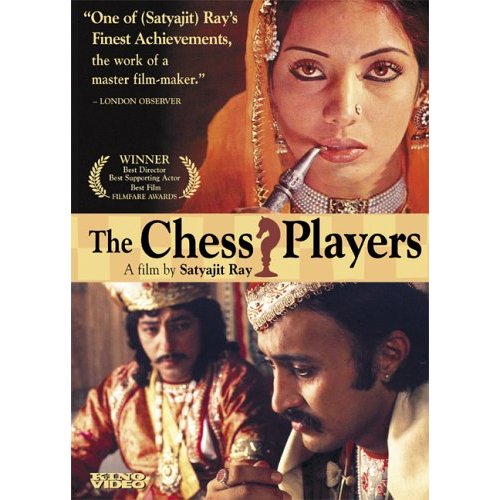
Shatranj ke Khilari: Chess Players
*Satyajit Ray*1977*Hindi*Amjad Ali Khan, Sanjeev Kumar, Sayeed Jaffrey, Shabana, Farida Jalal, Veena, Richard Attenborough, Tom Alter, Victor Banerjee*Based on a short story of Munshi Premchand*
The only movies I can remember which made me laugh more than this one-actually laugh, not smile or snigger-are Chaplin's Circus and Duck Soup. Of course this is far more refined and a different blend of tea.
This is Lukhnow, 1856, a year before the anti-colonial uprising. Kite strings entwine in the sky , cocks fight to the death, rams exchange head blows, the crowds yell and scream . Lukhnow, the city of nawabs, Shiraz-e-Hind, the Constantinople of the East, birth place of Naushad and Begum Akhtar. City of Kathak and Thumri. Pulao, biryani, kababs--"the garden, granary and the queen of provinces". This is a film as much about a city that was as about what happens.
The province of Avadh ( Oudh in anglese ) in which the city lies, was at the time being "ruled"-the British sword is sheathed but ever ready-by Nawab Wajid Ali Khan. This is Amjad Ali Khan's finest performance. Is this really Gabbar, the death spewing snake of Sholay, whose dialogues are now proverbs? In the hands of Ray, Amjad's clay is transformed into the effete, dance loving, poetry composing, bemused Wajid Ali Shah, born to be a puppet-king, if king at all. He maintains a harem of 400 concubines, loves kite flying, dresses up as a Hindu god and dances with the girls in raas-leela, has many "muta" ( Persian for pleasure ) wives for three or thirty days, says his prayers five times a day, won't touch a drop of wine, and is the patron-founder of the lauded Lukhnow school of kathak ( a classical Indian dance ), of which we are treated to an exquisite performance in the course of the film. The Nawab's eyes moisten and a lump forms in his throat as he sees the dance.
Mirza Sajjad Ali ( Sanjeev Kumar ) and Mir Roshan Ali ( Sayeed Jaffrey ), two hereditary landlords, living off taxation, passing their lives in blissful idleness, chewing pan and smoking their hookahs--quite in love with life and themselves, flitting from diversion to diversion--have currently made chess the centre of their lives, and, as chilum follows chilum, the comrades straddle the board from morn to eve--obsessive like the internet, maybe--much to the discomfiture of at least one of their wives. Mirza's shrewd and lovely wife, inimitably portrayed by Shabana--Shabana smoking a hookah!She brings range and perfection of nuance to any role--she has the ability to lose herself in a role, yet retaining perfect control. Farida Jalal, as the second wife, is cuckolding Mir Sahib, who is far too stupid and trusting or unwilling or uninterested to know what is going on right under his nose. The Mirza's uncontrollable fit of laughter, as he rolls up in spasm after spasm after spasm, amazed at his friend's naivete is an absolutely incredible feat of acting, never seen in the annals of cinema. Frustrated at being neglected on account of the game, she contrives to hide the chess pieces. After hilariously desperate endeavours to find another set, even taking them to the house of a dying attorney, who exhales his last even as the chess-pals fiddle with a chess board with pieces which decorates a side-table in the drawing room, they finally settle on continuing their game using vegetables--tomatoes and onions as chess men. Outwitted, Shabana angrily hurls the pieces at the friends. They decide to shift the game to the Mir's place, where we are treated to another comic interlude of cuckoldry.
Meanwhile, the bigger game is in progress. Lord Dalhousie, the governor-general in Calcutta, sends General Outram (Attenborough, another delectable performance ) to Luckhnow ( six hundred miles in six days, with thirty changes of horse ), with clear orders to take over the administration of the province. Veena as the Queen Mother, Victor Banerjee as the Prime Minister, Tom Alter as the urdu speaking aide de camp Captain Weston, all give indelibly memorable performances. Veena particularly, as the betrayed and wounded mother of Wajid Ali, is marvellous in her defiant yet fore-doomed cry for justice, to Queen Victoria and to heaven. The peaks in this film are too many to single out, The film is a himalayan achievement in the annals of Indian cinema, deserving more accolades than it has received.
Finally the chess friends retreat to a hovel in the countryside to pursue their game in peace. They quarrel over the game, and, already in bad humour because of mosquitos and lack of a light for his smoke, he taunts his companion about the doings of his unfaithful wife, the talk of the town. Angered Mir Sahib fires his pistol.
As the gun explodes, we are treated to a panoramic sight of a rag-tag British force---cavalry, infantry, bullock carts, elephants, camels, muskets---on their way to take over Lukhnow. Deadly enough, come to think of it.
This gunshot reminds me of the plop of the stolen necklace in Pather Panchali as it sinks into the algaed water. It is an inspired moment and marks the conclusion of one era and the start of another.
"How can we, who couldn't manage our wives, face the British ?", philosophically rues Mir Roshan Ali. They continue their game, waiting for the cover of darkness to sneak home.
The film is less about politics and history than about the confrontation of civilizations. Ray, with his oriental heart and western intellect, is well qualified to tackle this theme. It bears repetition that not one but each of the seven leading actors have given performances of amazing fluidity and power. Certainly no one who understands Hindi or Urdu should die without seeing this movie twice.
Review: Vincent Cranby
Wiki on the film
Review:Jay Antani
Friday, January 8, 2010
Masoom ( Innocent ) 1983
**Shekhar Kapur**Naseeruddin Shah, Shabana, Saeed Jaffrey, Tanuja, Supriya Pathak, Urmila Matondkar*Gulzar ( script )*
Shekhar Kapur's first film, from where he took off into a variegated career spanning the likes of Mr. India, Bandit Queen, Elizabeth.
It is always nice to punctuate life with an occasional Bollywood flick ( as a relief , not to mention a return to one's own roots ), and this one, coming from the yet budding talent of Shekhar Kapur, supported by a script from the sensitive and sentimental Gulzar, is a pleasant enough specimen of the genre. Shekhar wisely may have decided to line his pocket with a block-buster or two ( this was followed by Mr. India with it's inimitable and immortal villain-comedian Mogambo ) before getting into the more serious and riskier waters.
D.K.Malhotra ( DK for short ) and Indu are an upper middle class Delhi based couple who along with their two ebullient school going daughters, share the common yet uncommon joys of familial bliss, depicted with deft and light strokes. There is a charming song-dance sequence at a party by Naseerudin Shah and Jaffrey in which their comic talent as well as plasticity of limb and torso is used to good effect.
A telegram from Nainital serves as the spanner in the spokes. It is from the dying schoolmaster who is in charge of an illegitimate son of DK, the result of a brief affair soon after his marriage to Indu. DK was unaware of this offspring, since the mother chose to disappear from his life. The mother herself dies, leaving his charge to the good hearted school master.
DK has to bring the boy into his family against the wishes of his wife. The daughters take to him immediately, and the movie revolves around the family drama of the wife's reaction to the husband's confessed infidelity, and her overt resentment to the boy.
At best, it is a drama of childhood, a boy innocent of his own illegitimacy, and his consuming need for love and parents. Shabana is a fine actress, expressive in her silences, and the fire-brand on screen which she is in real life. Her gradual melting towards the unwanted boy is a great performance. Who can forget her roles in Shyam Benegal's Ankur and Ray's Shatranj ke Khilari Naseeruddin also is an actor of range and versatility, the sort for whom Hindi cinema has not proven worthy. He is at his most natural best in Monsoon Wedding.
Shekhar Kapur's natural ability enables to steer clear from being totally formulaic, while yet remaining in the safety zone of commercial viability and popular expectations. It's a movie which gives hope for better things to come. It's a different question if they did. At least he made it as far as Hollywood.
Subscribe to:
Posts (Atom)