A documentary about the invasions and occupations in Asia as well as the Pacific war. It conveys many ( to me ) new insights into the history of that period. The footage at most places seems the worse for wear and the japanised-english in which reports of interviews, letters and statements is read out is rather jarring.
The film gives an authentic feel of the scale and audacity of the Japanese military enterprise in which a small, but tightly disciplined and united nation is able to crush, over-run and occupy vast territories in less war-like regions of Asia, while engaging the mighty "sleeping lion" of the USA in a naval confrontation of unprecedented magnitude. Looking at this film, it is alarming to see the extent to which the adventure was successful, as Asia is prostrated to the advancing juggernaut from the East. What was the source of this energy and power? What makes a country powerful? The aborted military dream is followed by the economic and technological miracle in the second half century.
It is obvious that the secret is the principal of human organisation, whereby a body of men, united by common interest, force, or a common ideal by the sheer exponentiation resulting from their aggregation, become a kind of atom-bomb of shared purpose, for good or bad.
Friday, December 18, 2009


Thursday, December 17, 2009
The Mirror : fragments of the past

Tarkovsky speaks about "The Mirror"
An enigmatic but alluring film which is unlikely to get the second view it deserves. The above link from the director's own mouth gives a string to start from and makes the director's intention more than crystal clear. As he explains, it is intended as a literal and completely authentic cinematic autobiography, extremely sentimental, emotional and nostalgic. Tarkovsky's mother along with her two children was abandoned by the father at an early age and the mother, who is the central figure in the film, brought them up in conditions of extreme deprivation, giving them a kind of education almost unconceivable under the circumstances. The father was a poet of depth whose poems are often quoted in his films, including this one. The father is projected in a positive light, and was always esteemed by the mother, such must have been the complexities of the situation. In any case the above linked explanation should be read by any one intending to see the movie as a minimal road map.
Again borrowing from the director's elucidation, the film is a collage of memory elements fused into a whole, a broken mirror assembled lovingly to capture and preserve what has ceased to exist .
About half way through, while enjoying the wistful imagery and the sound track ( he often uses classical music and some choral pieces of Bach are used to great effect, capturing the director's fundamentally religious orientation ), I was left virtually clueless about what was going on, except Wiki's assurance that it was about his own life and not intended to make sense as usually found, and not to seek a narrative chain. Anyway, I went through to the end, more for record's sake, as it were, and found myself more and more immersed in the mood of his memories. Tarkovsky's camera is ever wistfully evocative, and the mists of memory, as they are lifted, one after another, are charged with a kind of suppressed passion, bordering on a kind of religious fervor towards life itself.
If there is another occasion, it will certainly have more shape...
Wednesday, December 16, 2009
Do the Right Thing ( 1989 ) : portrait of a riot
 *Spike Lee*1989*115m*
The film culminates in a riot in which a black American is killed by the police and an Italian owned shop is burnt down in the aftermath.
It is not necessarily about interracial tensions in one corner of the globe but a sociological study of hatred which gets organised across groups of individuals separated by colour, caste, status or language. Almost anything can serve as an occassion or excuse for such behaviour which is a kind of virulent eruption which is as recurrent a phenomenon in this country as in America.
A beautifully enacted and thoroughly gripping film which doesn't let your attention flag even for a moment. The film does not particularly represent black anger against racial discrimination since the Italian pizzeria owner is shown in a more sympathetic light. The mood of the film is sad rather than angry. However it does give us a brilliantly etched, detailed and utterly realistic close-up of the life and minds of the black community in a particular stratum, and the way they come to grips with their past and present. It seems all too real, natural, understandable and yet very sad as the destiny and karma of human beings everywhere. The film ends with counterpoised quotes and portraits Martin Luther King, advocating the Christian ethic, and another from Malcolm X, stating the inevitability of violence in the interest of securing justice.
Roger Ebert's Essay for the Criterion Collection
Sunday, December 13, 2009
Yojimbo 1962 : out-westerning the western
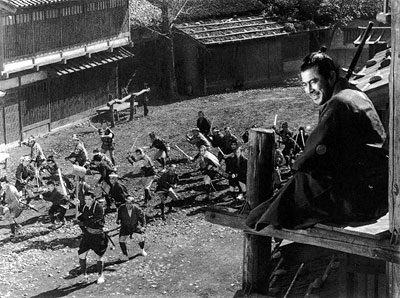
Whether he draws inspiration from the American western or vice versa is arguable, but certainly we have a fast action entertainer of the Sholay genre. The renowned film-maker once again puts his full cinematographic plumage on display. It also presumably displays a period of Japanese history, and the one lone fire-arm--a revolver which exerts considerable influence in the balance of power in the gang war--as symbolic of that country's emergence from it's feudalistic era to the period of rapid westernization, which started in the period in which the action occurs..
There is not much I find to write about. It's a film beautiful on the eye in it's dusty, grimy, wind-lashed setting. It resembles the grey, ramshackle, disintegrating world like Gold Rush. It is engrossing to observe the unfamiliar mannerisms, cadences of speech and body language. Bloodshed, violence, meanness, treachery--the full dose of villainy is there.
Sadly, the most popular of his films, both on it's home-ground as elsewhere. A good one, I guess, but just not my genre.
Kurosawa*90m*
Criterion Essay, Alexander Hanske
Roger Ebert's Great Movies Essay
Saturday, December 12, 2009
Aranyer Din Ratri ("Days and Nights in the Forest") 1970
*Ray*1970*115m*
Somewhere in the fifties or sixties, four Bengali young men in their twenties, seek respite from the daily grind, as they journey in an Ambassador car to spend a week in the tribal belt of Bihar or Jharkhand. They manage to lodge themselves in a government rest-house by bribing and brow-beating the care-taker, whose wife is ailing. And then they encounter an elderly gentleman , his daughter and widowed daughter-in-law, and romance, sadness, along with rumbling of bygone tragedies, blossom in this wilderness.
These are middle class people, government officials or employees in the jute industry, with anglo-bengali thinking, speech and ways--in fact an authentic portrait of Indians not very different than in the present racier times. Ray's characters are a cross section of ordinary people of a time and place, and through meticulously chiseled cinema he creates a world and an era, which evokes gratitude ( because you see yourself there all the time ) and admiration for the apparent ease and effortlessness. There is the sound and rhythm of the village fair, with it's roulettes, a very ricketty dwarf of a giant wheel, and pakoras served on pieces of newspaper, and the dark and flirtatious santhal beauties. It's the period when one and two rupee notes were still respectworthy.
Not much happens in this movie. It's made of ordinary, everyday things, like people bathing, conversing inconsequentially, mutual fun poking, male camaraderie, getting drunk and dancing on the road at night, always remaining within while nudging at the limits of accepted social norms. Yet for all it's apparent lack of mind or earth shaking events, it grips one's attention and interest till the curtain credits at the end disappear. Because this is a world and these are people one can immediately identify with.
Each of the director's movies is fresh as though his wellsprings of creation are inexhaustible. Each is a discovery.
This gentle and melodious film is as unputdownable as any. Another from the master's vineyard
*Sharmila Tagore, Soumitra Chatterjee, Simi Garewal*.
Subscribe to:
Posts (Atom)