Sunday, September 5, 2010

Clean, Shaven

Lodge Kerrigan (director), 79m, 1994

The film depicts the world through the eyes of Peter Winter, a schizophrenic in his twenties. The depiction of insanity has grown into a genre ( List from Wiki) and schizophrenia is a sub-species. Some films, like A Beautiful Mind and Proof, romanticize the condition. Ingmar Bergman, in The Hour of the Wolf and Through a Glass Darkly has given cameos which seem more like generalized reflections about the human condition. Stanley Kubrick cashes it into a horror in The Shining. What is very sure is that the inner world of a mentally sick person is a mysterious and by no means a glamorous one and an adequate representation of this harrowing widely prevalent disease will have to be awaited. Perhaps this can only be done by a film director suffering from schizophrenia, but if he could do that, he probably would not be one.

The present film deals with the condition with something like clinical honesty. Peter hears sounds with a heightened intensity (like electric wires humming) but this is more associated with narcotics than schizophrenia. He hears a threatening and abusive voice, presumably that of his father. He is obsessed with seeing his daughter, who was given to adoption. There are gruesome scenes of self mutilation--he is completely (but wait, nothing is that complete) possessed. The film has a superb climax, which resolves the plot threads on their own terms.

Kerrigan retains objectivity and does a fine job of not underplaying or romanticizing the condition. He shows it for the terrible thing that it is. What is most remarkable is the humanity and compassion he has retained. He is  reminding us that the mentally sick are human beings, no matter how extreme the disturbance. Schizophrenia is not something one is, but something one has.

Saturday, September 4, 2010

Sophie's Choice 1982

2 hours+, Meryl Streep (best actress)

This is a highly prolonged soap opera about a love triangle involving a non-Jewish holocaust victim, an endearing paranoid schizophrenic, and a twenty two year old aspiring novelist. The title of the film has entered the lexicon because of the agonizing choice given to Streep wherein she must doom one of her two children to the gas chamber. The holocaust is used as a background material to juice up, without appreciable success,  a film which has little to stand on. Talk about commercializing tragedies--it only means that we are beginning to forget. The plot is highly convoluted, as it usually is in films and novels of this grade, probably to give the audience something to chew on the way back home. Being an accomplished artist, Streep pulls off the unnatural feat of  speaking English with a real thick Polish accent and Polish and German like a native. Talented as she is, she comes close enough, making it ludicrous by a kind of reversed Uncanny Valley effect. It seems that it was these linguistic gymnastics which got her the award, since the role itself has little logic, neither does she succeed in uplifting it.
Review (Tim Brayton)

A Poem by Emily Dickinson

Because I could not stop for Death,
He kindly stopped for me;
The carriage held but just ourselves
And Immortality.

We slowly drove, he knew no haste,
And I had put away
My labour, and my leisure too,
For his civility.

We passed the school where children played,
Their lessons scarcely done;
We passed the fields of gazing grain,
We passed the setting sun.

We paused before a house that seemed
A swelling of the ground;
The roof was scarcely visible,
The cornice but a mound.

Since then 'tis centuries; but each
Feels shorter than the day
I first surmised the horses' heads
Were toward eternity.

Friday, September 3, 2010

The Hour of the Wolf

Bergman, 90m, 1968

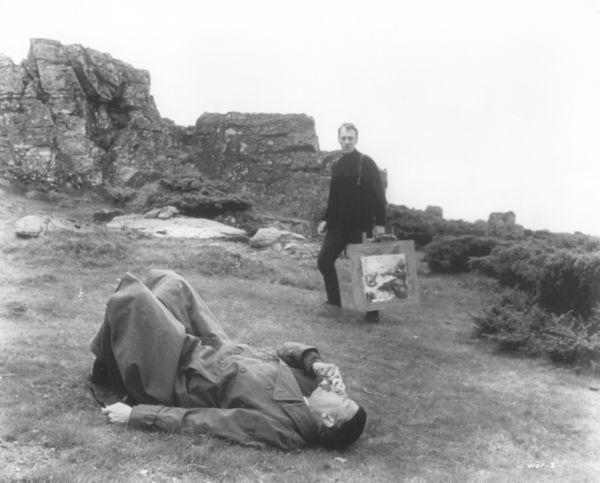
Max von Sydow plays an artist who arrives with his pregnant wife, played by Liv Ulmann, to settle in an isolated cottage on a hillock by the seaside. The story is about his inner demons and his descent towards insanity. The line between fantasy and the real is thin and you can decide for yourself, and is of no importance. These include the homicide of a boy, an attempt on the life of his wife, memories of being locked up as a child, and the ridicule poured on Sir Artist by his neighbors.

The film, which surely has autobiographical elements, deals with the theme which runs throughout Bergman's movies--the anxieties of living without faith. Without hope, consolation and an ordering principle of life, the mind, left to it's own resources of intellect, emotion and instinct, must veer on dizzy trajectories, at the mercy of demons of one's own creation. Bergman is an artist, a painter of the tempestuous sea that is the inner world of human beings. He sees no lighthouse--man is but a weed who happens to be helplessly afloat, tossed by the waves of fear, hate and desire.

The film is a hard watch even at it's modest duration. It lacks the focus and simplicity of Persona. Maybe too much has been crammed into it. We have had enough dose of Freudian nightmares by way of films. I am unlikely to give it the second viewing which it probably deserves. But maybe I will--a half digested would be masterpiece does not lodge comfortably in the mind.

Wednesday, September 1, 2010

Nazarin

Bunuel, 1959, 94m, Mexico

Nazario, a Christian priest, lives in a squalid Mexican neighborhood, surrounded by vagrants, petty criminals and street walkers. He has an upstairs room, its window serving as a perpetually open entrance. He carelessly allows his possessions, the coins and pots and pans to be filched. He doesn't bother much whether he gets to eat or not. He continues this quixotically pious existence till he finds himself harboring a woman, who, in a quarrel resulting from a theft of buttons, has killed another woman, .

Next we find him on the run  through the countryside in "civilian" garb. He soon lands himself in another soup where the unsought and unwanted reputation of a miracle worker is dumped on him. Two women devotees now cling to him in his misadventures, till the police catch up to him, and he is ridiculed, insulted and beaten by his fellow prisoners. He has arrived  at a stage when he can't take more of human nastiness. He finds it difficult to carry out the Christian teaching of forgiveness. As Nazario trudges along a dusty road, disillusioned and angry, a old woman offers him a pineapple. At first he refuses, too wounded to accept kindness. On second thought, he beckons to her to accept the offering,internally illuminated by her goodness. A flower blooms in the desert.

I don't know what Bunuel is trying to say except that the times call for a tougher brand of altruism  than mechanically offering the other cheek. That's just tinkering with the vast seas of suffering all around. As film, it has neither the outrageous surrealism of his silent movies like Un Chien Andalou and L'Age d'Or  nor the dark insights of The Exterminating Angel and Belle de Jour. The sounds and smells of a Mexican inner city streetside are poetically evoked in the early parts of the movie, and may be a second view would reveal more visual treats in the details.